
Context Graphs: The Missing Layer Between AI Agents and Enterprise Reality
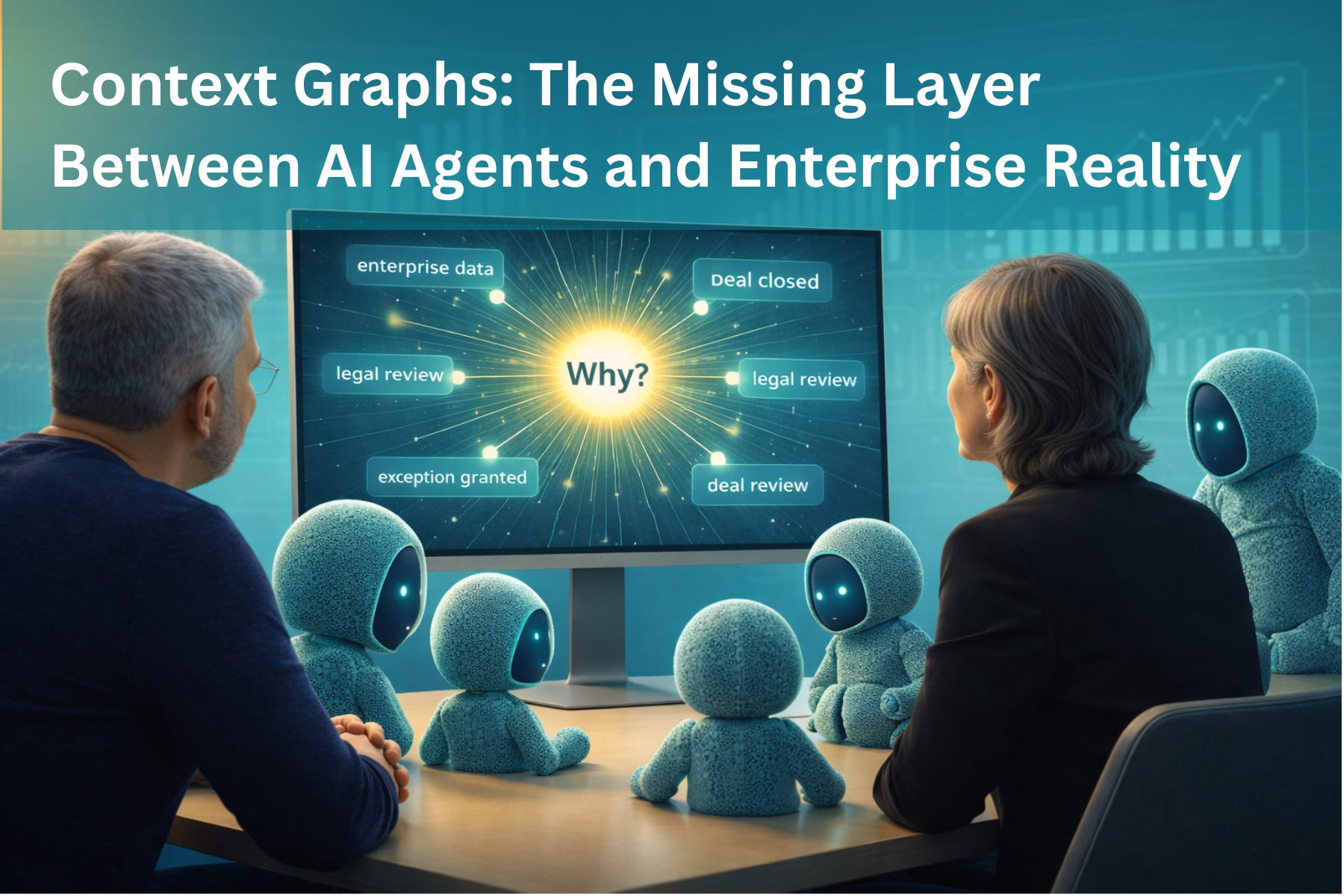
Context graphs capture the “why” behind enterprise decisions: policies, exceptions, and approvals. As AI agents move from answers to actions, that decision lineage becomes essential for safe scale.
Introduction
Over the past few weeks, “context graphs” went from a niche architecture idea to a serious enterprise conversation, kicked off by a clear thesis: the next major AI platforms will not win by storing more data. They will win by storing how decisions were made. [1]
That framing matters because it matches what most executives are seeing in production pilots: the hardest failures are not “the model got confused.” The hardest failures are “the organization didn’t leave behind enough context for an agent to act safely, consistently, and auditably.” Rules exist. Data exists. The “why” behind exceptions, overrides, approvals, and precedent usually does not. [1]
“Most ‘AI-powered’ systems still can’t answer a simple question: WHY was this specific decision allowed, under which policy and precedent? Context graphs capture decision traces as a living system of record for those ‘why’s,” Joanne Chen, General Partner at Foundation Capital
This article explains what context graphs are, how they relate to knowledge graphs, content graphs, GraphRAG, and event sourcing, and why they are becoming a practical design pattern for scaling enterprise AI beyond demos.
From Systems of Record to Systems of Decision
The last era of enterprise software created massive value by becoming systems of record: CRM, ERP, HRIS, ITSM. Those platforms became durable because they owned canonical objects and workflows. [1]
But “systems of record” capture outcomes, not the reasoning that produced them. A CRM stores “20% discount approved.” It rarely stores the evidence that justified the exception, the policy version applied, who approved it, what precedent was referenced, and what tradeoffs were explicitly accepted. [1]
Context graphs emerge from a simple observation: the enterprise runs on decisions, not just data. The deciding is where risk, cost, customer experience, and compliance actually live. If AI agents are going to execute work, the organization needs a durable, queryable record of decision-making, not just a snapshot of final state. [1]
A helpful metaphor from the “how to build a context graph” discussion is the “two clocks” problem:
The state clock: what is true right now (current deal value, current ticket status, current config).
The event clock: what happened, in what order, with what reasoning (the negotiation, the escalation logic, the rationale for changing timeout settings). [5]
Most enterprise infrastructure is built for the state clock. Agents that operate in real workflows need the event clock as well, because that is where precedent and accountability live. [5]
What a Context Graph Is (And What It Is Not)
A context graph is best understood as a graph-shaped “memory” of enterprise decisions and the context that made them legible.
Foundation Capital’s definition is direct: a context graph is “a living record of decision traces stitched across entities and time so precedent becomes searchable,” and it is explicitly not the model’s private chain-of-thought. [1]
The core unit: the decision trace
A decision trace is a structured record of how context turned into action:
Inputs gathered across systems (facts, signals, constraints)
Policies evaluated (including versioning)
Exceptions invoked (and why)
Approvals collected (who, when, channel)
Changes committed (what was written back, and where)
Outcome later observed (did it work, did it create downstream issues) [1]
The canonical example in the recent writing is a renewal agent proposing a 20% discount even though policy caps it at 10%, because it pulls incident history, an active escalation, and a prior approved exception as precedent, then routes approval to Finance. The CRM stores the final discount. The decision trace stores what made that deviation defensible. [1]
Two layers: operational context and decision context
A useful refinement is that most enterprises are missing two layers of context:
Operational context (foundation): identity resolution, ownership, relationships, and temporal state across systems.
Decision context (next layer): decision traces, precedent, auditability, and replay. [1]
This distinction matters for executives because it explains why “we connected our documents to RAG” often stalls. You can retrieve text and still be missing the organizational structure needed to act (who owns what, what changed when, which policy applies, who can approve). [1]
What it is not
A context graph is not “just a vector database.” Vectors are excellent for semantic similarity, but they do not inherently represent explicit relationships, provenance, or decision lineage.
It is not “just a knowledge graph.” Knowledge graphs can model entities and relationships well, but many deployments stop short of capturing the workflow execution path and the decision trace that makes agent actions auditable. [1]
It is not “agent memory” in the sense of chat history. Chat history may be useful, but it is not a durable, queryable record of what the organization decided and why it decided it.
Instead, a context graph is an architectural commitment: treat decisions and their lineage as first-class enterprise data. [1]
Related Topics, In Plain English
Executives are seeing a thicket of adjacent terms. Here is a practical map.
Knowledge graphs
A knowledge graph represents real-world entities (customers, products, policies, locations, people) and the relationships between them. IBM’s definition captures the essence: entities plus relationships, stored and queried as a graph. [8]
Knowledge graphs help when your problem is “connect the dots” across customers, products, people, and systems. They shine for navigation, reasoning over relationships, and joining data that does not fit neatly into tables.
Content graphs
A content graph is similar, but content-centric. It organizes digital assets (documents, articles, tickets, contracts, call transcripts) into a network connected by metadata, topics, structure, and semantic relationships, improving search, reuse, and discovery. [1]
In practice, many enterprises will build a content graph first, then enrich it into a context graph by adding decision traces, time, and workflow actions.
Ontologies
An ontology is the schema: the vocabulary of entity types, relationships, and constraints that define “what things mean” in a domain. The context graph discussion often includes a healthy tension between prescriptive ontologies (define upfront) and learned or emergent structure (let usage reveal structure). [1]
The executive takeaway: do not let “perfect ontology” become the blocker. You can start with a small, high-value slice (renewals, claims, escalations, approvals) and expand as you capture traces.
GraphRAG and hybrid retrieval
Most enterprise AI teams have already learned the limits of “RAG with vectors only.” Vector search is strong at “find me the most similar passages.” It is weaker at questions that require structure, aggregation, or multi-step traversal across related items.
This is one reason GraphRAG has gained attention. Microsoft Research describes GraphRAG as combining text extraction, network analysis, and LLM prompting to “richly understand text datasets” using LLM-derived knowledge graphs. [6]
For executives, the practical implication is not “we need a new buzzword.” It is that graph-based retrieval can materially improve outcomes for questions like:
“What are the top three root causes behind escalations for this product line, and which mitigations worked last time?”
“Which policy exceptions have we been granting repeatedly, and who approves them?”
“Which customers look like this one, and what retention actions actually changed the outcome?”
These are not “document lookup” problems. They are “connected reasoning” problems. Graphs are designed for connected reasoning. [6]
If you already have a content graph, GraphRAG-style techniques become far more powerful because the model is no longer guessing relationships from scratch each time. [6] [7]
Event sourcing and “why it became true”
Many of the context graph ideas rhyme with event sourcing: capturing change as a sequence of events so systems can replay history and maintain auditability. [10] [11]
The difference is emphasis. Event sourcing focuses on state transitions. Context graphs focus on decision transitions: the reasoning, exceptions, and approvals that justify a state change. [1]
Why Context Graphs Matter to Enterprise AI Leaders
Context graphs are not academic. They address four board-level realities of AI deployment: auditability, repeatability, scale, and competitive differentiation.
1) Auditability becomes a product feature, not a governance tax
As soon as an agent touches customer pricing, claims adjudication, hiring funnels, clinical workflows, or security response, you will be asked: “Why did the agent do that?”
A context graph is an answerable system. The trace becomes the audit artifact: what did the agent see, what rule did it apply, what exception path did it take, who approved, and what precedent did it reference. [1]
This shifts governance from a gate into an asset. Instead of trying to prevent every edge case, you instrument edge cases so the organization learns from them. [1]
2) Precedent turns exceptions into compounding learning
Most organizations repeatedly relearn the same edge cases because precedent lives in people’s heads and scattered conversations.
Context graphs make precedent searchable. The organization can ask: “When have we approved an exception like this before?” and route the agent accordingly. [1] [3] [4]
This is where the compounding effect becomes real: each human-in-the-loop decision can become a reusable pattern for the next one, even before you attempt full autonomy. [1]
3) Agents become safer because they operate with organizational physics
One of the more ambitious claims in the recent writing is that mature context graphs function like “world models” of the organization, enabling simulation and “what if” reasoning. [5]
Even if you do not buy the full simulator vision, the practical point holds: agents are more reliable when they can traverse relationships, time, ownership, and precedent instead of guessing from isolated text chunks. [1]
4) Competitive advantage shifts from model access to context accumulation
Models are increasingly commoditized. Many firms will have access to comparable frontier capabilities. Differentiation will come from context: the unique trace of how your organization decides, escalates, resolves conflicts, and serves customers. [1] [2]
That is why you are seeing senior builders talk about missing “operational context layers” and the need for an “event clock,” not just a static snapshot of entities. [2] [5]
Actions for enterprise AI leaders: a pragmatic 90-day plan
The trap is to treat this as a grand data-modeling initiative. The winning pattern is to start from a workflow where agent reliability matters, then build the minimum context graph that reduces ambiguity and captures traceability. [1]
1) Pick one decision-heavy workflow where “why” matters
Good candidates share three traits: frequent exceptions, cross-system context, and real risk if the agent is wrong.
Examples:
Deal desk discounting and approvals
Support escalation and root cause learning
Vendor onboarding and security exceptions
Policy-driven HR cases (leave, accommodations, investigations) [1]
2) Define your “minimum viable graph schema”
Do not start with an enterprise ontology. Start with:
8 to 15 entity types (Customer, Product, Contract, Policy, Ticket, Incident, Approval, Exception, Owner)
15 to 25 relationship types (references, governed_by, supersedes, approved_by, exception_to, impacts, similar_to)
Use business language. The goal is shared clarity, not academic completeness. [1]
3) Build the content graph first, then layer in decision traces
In practice:
Ingest 2 to 4 high-value repositories (ticketing, CRM notes, policy docs, runbooks)
Extract metadata and entity links
Store relationships in a graph store
Keep original content addressable for retrieval and citations [1]
4) Instrument the workflow to emit decision traces
This is the context graph leap. Each agent run should produce a structured trace:
Inputs consulted (with timestamps and permissions)
Rules or policies evaluated (versioned)
Exceptions invoked (and rationale)
Approvals requested and granted (who, when)
Action taken and written-back state [1] [4]
The key is not choosing a specific graph database. The key is deciding that decision lineage is first-class data and designing your system to emit it. [1]
5) Make it auditable by default
Two executive-level requirements:
Every agent action should have a “show your work” trail suitable for risk and compliance review.
Every retrieved fact should be attributable to a source (document, system record, trace event). [1]
This is how you turn “AI governance” from a set of review meetings into a structural capability.
6) Measure outcomes executives care about
Avoid vanity metrics like “tokens saved.” Use:
Deflection and resolution quality (support)
Cycle time and exception rate (deal desk, procurement)
Policy compliance and audit findings (legal, security)
Rework rate and escalation frequency (ops) [1]
Then tie graph coverage to outcomes: as more traces and relationships are captured, exception handling should improve and human escalations should drop. [1]
This pattern is already showing up in production systems. As explored in the companion AI Realized Now article, “Vertical AI: Context-Rich Systems for Enterprise Execution,” vertical AI products are increasingly embedding context graphs, ontologies, and verification layers so AI can operate safely inside real enterprise workflows.
Key Takeaways & Executive Guidance
Treat context graphs as AI infrastructure, not a knowledge-management side project. They persist decision traces so agents can act with accountability. [1]
Use decision traces to make precedent searchable. Exceptions are not noise. They are where risk and value concentrate. [1] [4]
Adopt a hybrid retrieval mindset. Vector similarity finds relevant passages; graphs enable multi-hop reasoning, lineage, and auditability. [6] [7]
Start with one workflow and instrument it end-to-end. Capture “why” at decision time, not after the fact in analytics pipelines. [1]
Design for time, provenance, and permissions from day one. If you cannot replay the decision safely, you cannot trust autonomy at scale. [5] [10]
Three questions to pressure-test your roadmap
Which workflow in your organization has the highest “exception load,” where humans routinely override rules to get work done? [1]
If an agent took a high-impact action tomorrow, could you reconstruct exactly why it did so in a way your risk team would accept? [1]
What is your minimal schema for “decision traces,” and who owns versioning of policies, precedents, and approvals as first-class data? [1]
References
[1] AI’s trillion-dollar opportunity: Context graphs, Jaya Gupta and Ashu Garg, Foundation Capital, 2025
[2] Kirk Marple (@KirkMarple), X post, 2025
[3] Jaya Gupta (@JayaGup10), X post, 2025
[4] Anshul Gupta (@agupta_108), X post, 2025
[5] The Context Graph: AI’s Trillion-Dollar Opportunity, Justin Johnson, Run Data Run, 2026
[6] Project GraphRAG, Microsoft Research, 2025
[7] From Local to Global: A Graph RAG Approach to Query-Focused Summarization,” Darren Edge et al., arXiv:2404.16130, 2024
[8] What is a knowledge graph?, IBM Think
[9] What is RAG (Retrieval-Augmented Generation? AWS
[10] Event Sourcing, Martin Fowler, 2005
[11] Event Sourcing pattern, Azure Architecture Center, Microsoft Learn
[12] Vertical AI: Context-Rich Systems for Enterprise Execution, AI Realized Now, 2025
In Case You Missed It:
Here’s the link to AI Realized Issue #12
Join the AI Realized Community and received invitations to exclusive events and practical content for executives adopting AI.
Brilliant insight: AI adoption fails when organizations treat it as a data/rules problem rather than a 'why' problem. Context graphs aren't just technical elegance—they're the organizational identity made explicit. Without capturing decision reasoning, you force teams to treat AI as a separate system, not as how work actually gets done.